
For most business websites, a full audit takes one to two weeks, depending on the number of pages and how much historical data is available in Search Console.
How We Audit a Website Before Recommending SEO Work?
Admin / July 23, 2026
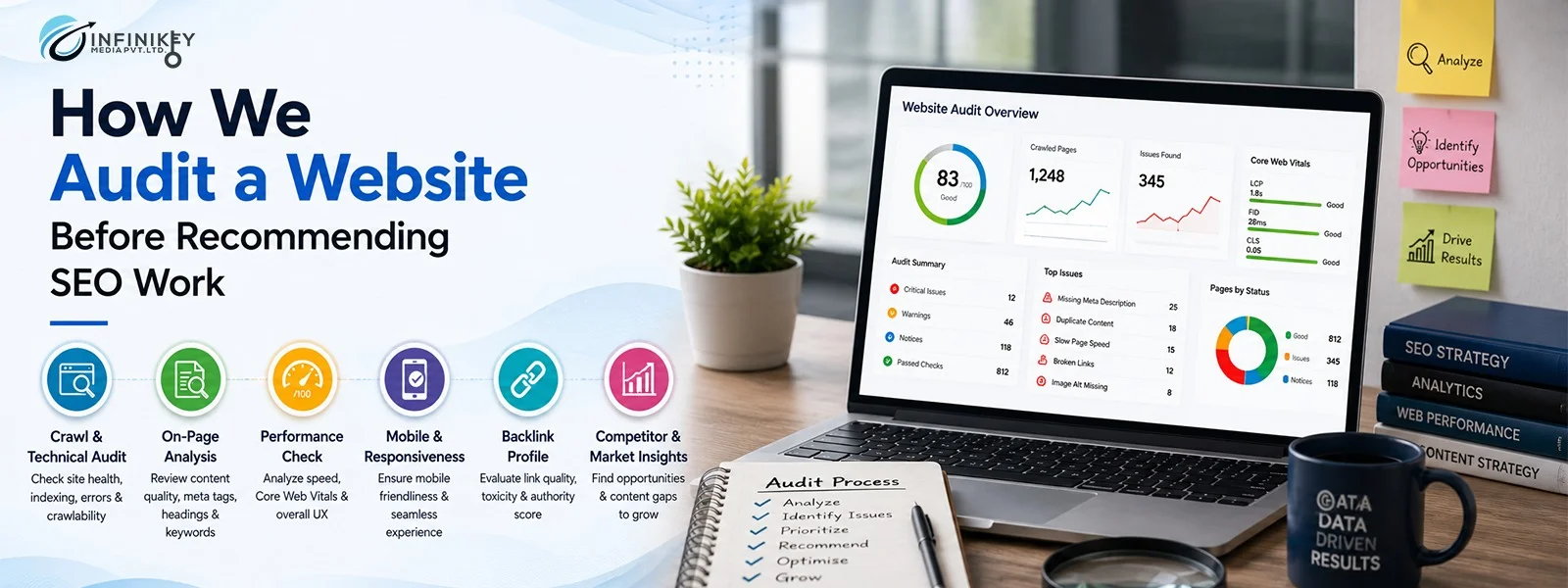
A walkthrough of what an SEO audit actually looks at, and why the audit comes before any strategy — not after.
Most SEO pitches start with promises. Ours starts with a list of things we haven't checked yet. Before we recommend anything — new content, new pages, a link-building plan — we look at what's actually happening on the site today. Here's what that process covers and why each part matters.
Technical health first
A site can have great content and still lose to a competitor with worse content, simply because Google can't crawl or load it properly. We check page speed, mobile rendering, crawl errors, broken links, and whether important pages are actually indexed. For an industrial site with a large product catalogue — the kind of site we've built city pages for with clients like Rudra Aluminium Formwork System — this step alone often surfaces pages that were never indexed at all.
What's already ranking, and for what
Before suggesting new keywords, we pull up what the site currently ranks for. Sometimes a page is ranking for the wrong term entirely — built for "tensile structure manufacturer" but actually showing up for a totally unrelated search. That mismatch is common on older sites that have grown page by page without a keyword plan behind them.
Content and keyword gaps
We compare what the site says against what people are actually searching for. A manufacturer or supplier — say, a pipe and tube mill machinery company like Nirmal Overseas — often has strong product pages but no content answering the questions a buyer researches before ever reaching out. That gap is usually the fastest place to find opportunity.
Backlink profile review
We look at what's currently linking to the site, whether any of it looks spammy or irrelevant, and where the realistic opportunities are to build more. This step also flags anything that could actively be holding rankings back, which happens more often than people expect on older sites picked up from a previous agency.
Competitor comparison
Finally, we look at who's already ranking above the site for its target terms, and why. Sometimes it's a stronger backlink profile. Sometimes it's simply a page built around clearer search intent. Either way, this is what turns an audit into a plan instead of a checklist.
An audit doesn't tell you everything is broken — usually it's two or three specific things holding a site back from where its content quality should already have it. Finding those two or three things is the actual point.
FAQs
-
How long does an SEO audit take?
-
Do I need an audit if my site is new?
-
What tools are used in an SEO audit?Google Search Console and Google Analytics cover most of it, along with a crawler to check technical issues site-wide. The tools matter less than knowing what to look for in the data.
-
Will I get a written report after the audit?Yes — a usable audit should end with a clear list of what's wrong and what to fix first, not just raw data.
-
Can an audit find why traffic dropped suddenly?Often, yes. Sudden drops are usually tied to a technical issue, a Google algorithm update, or lost backlinks, and an audit is the fastest way to narrow down which one.


 ⭐ Write a Review